
Governance & trust
Contracts, audit, metering, tenancy and security.
 Governance & trust
How to survive warehouse schema changes without breaking dashboards
Upstream dbt jobs renamed an invoice column to amount_usd, but central semantic mapping and model tests kept dashboards running without a blip. Governance & trust
Multi-tenant customer dashboards: row-level policy isolation
How platform engineers secure embedded customer dashboards using JWT claims, row-level policies, and query metering in a thin semantic layer. Governance & trust
Eval harness: agent vs dashboard same-number tests
Create an eval harness that asserts agent answers match dashboard numbers for the same metric requests.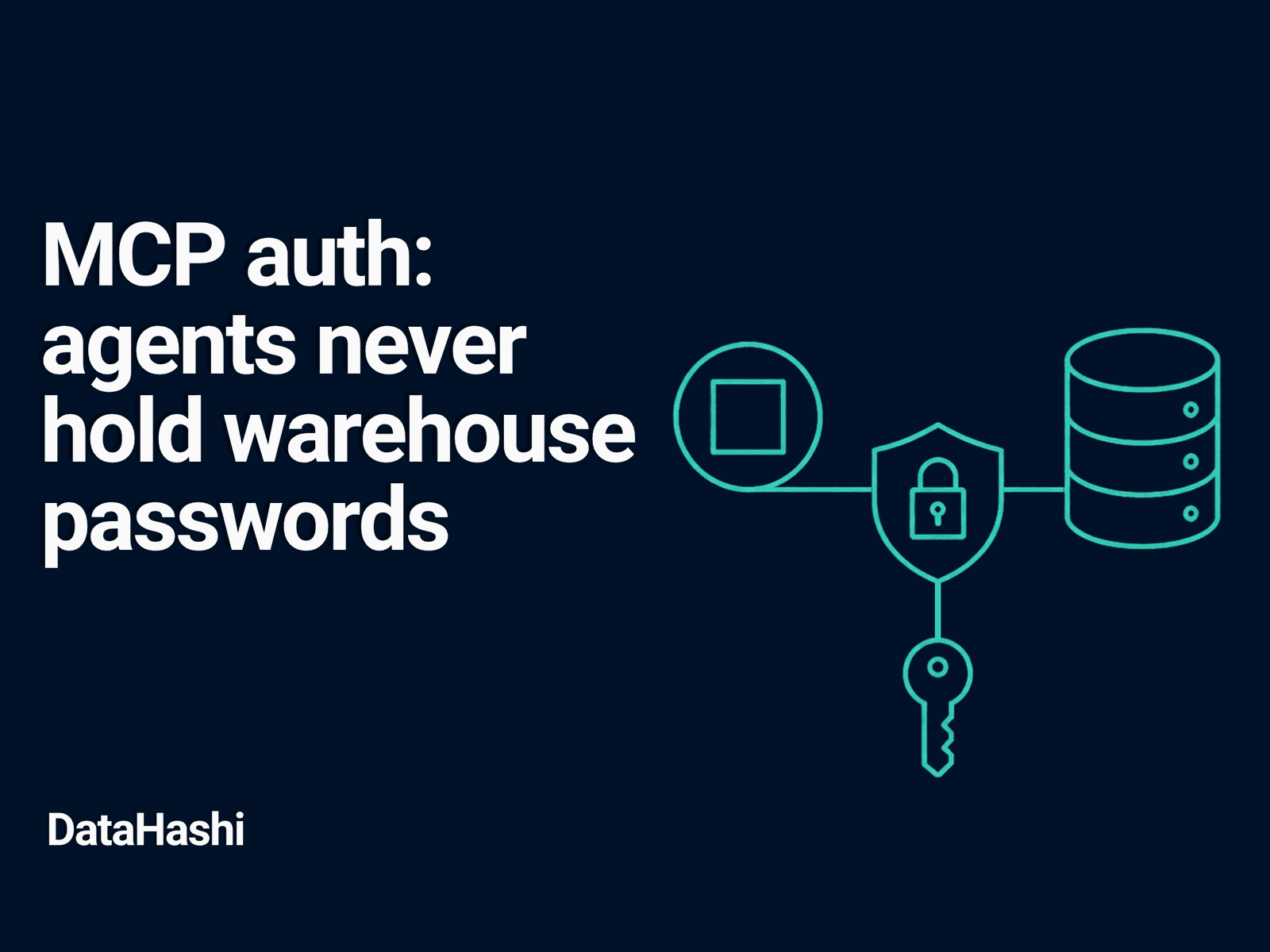 Governance & trust
MCP auth: agents never hold warehouse passwords
Set up MCP auth so agents never hold warehouse passwords - credentials stay server-side behind the semantic layer. Governance & trust
Prove two consumers return the same number
Run a practical same-number test between two consumers (dashboard and agent) against one metric request. Governance & trust
Metric contracts: the same-number test
A metric contract is a shared definition you can test. If two consumers disagree on the number, the contract failed. Governance & trust
The engine never opens your warehouse
Why datahashi stopped holding warehouse passwords — compile and execute are different jobs, and agents make the wrong trust boundary expensive. Governance & trust
Audit trails for agent answers
Implement audit trails for agent answers tied to metric requests so compliance can replay who asked what. Governance & trust